Sunday, May 25, 2008

Perception is Reality

That old internet dowager, the House of Bishops/Deputies listserv, is usually a little slow on the uptake, so its members are only beginning to share their wisdom over the controversy that won't quite go away--namely, a pattern of conveniently incoherent intepretation of canons on the part of the Presiding Bishop and her staff. Some express annoyed dismay that we're talking about it at all. To them I had this to say earlier today:

What follows is nothing new. It isn't anything that hasn't been said many times before, including by me. But one should never tire of telling the truth when it needs to be told, and the responses on this thread make it abundantly clear that some critical elements of the truth have not yet sunk in with a lot of the members of this list.

So, here goes ... one ... more ... time.

Everybody I know is willing to stipulate to the substance of the charges against Bishops Cox and Schofield--that they have indeed "abandoned the communion of this church" (i.e. TEC). (One could make a case that the abandonment canon was the wrong one to use in their cases, but that's another conversation.) So nobody on either "side" of this mess is contesting the outcome--that Bishops Cox and Schofield be no longer allowed to exercise ordained ministry as representatives of the Episcopal Church. That ball is not in play and nobody is trying to put it in play.

Opinions vary on this, but I, for one, do not attribute any dishonorable or malevolent motives to the Presiding Bishop or to Chancellor Beers with respect to how the depositions were handled at the March HOB meeting. I think it was an honest mistake on their part. I agree that they were following established precedent. Nor do I blame the bishops for not objecting at the time; they too were following precedent and assumed everything was on the up and up. They may have been culpably ignorant, but they were, I would wager, nonetheless ignorant. Nobody was trying to pull a fast one, and nobody was sitting mutely while an injustice was being perpetrated. But, as has been amply demonstrated, it was a bad precedent, and two wrongs don't make a right. There is a legitimate distinction to be made between the precedent of a judicial opinion and the precedent of an administrative practice. The former helps shape the body of legal tradition. The latter, when it is pursued in error, only compounds the error, and makes it only that much more imperative that the error be rectified.

All this is taking place, of course, in a wider context of grave crisis in TEC and in the Anglican Communion. We are staring at each other across spiritual minefields, from foxholes and trenches. The general level of trust and presumptive good will is at what could be an all-time low in our history. The "bonds of affection" have been strained not only *to* the breaking point but well beyond that point. In such a conflicted environment, process becomes all the more important. Even when we cannot trust one another as brothers and sisters in Christ, a shared commitment to due process--to the rules we agreed to live under in less cantankerous times--becomes the only bit of glue that can bind us together, short of a completely sovereign and veritably miraculous intervention of the Holy Spirit.

In such a conflicted state, when mutual adherence to constitution and canons is all we have to hang onto, the strict observance of those canons by everyone involved takes on paramount importance--more importance than in more "normal" times, when the resilience of the organism is more capable of tolerating some technical defects in processes like the deposition of bishops. We don't live in such times presently, and, as a body, we don't have the resilience to withstand such defects. There isn't enough trust to go around at the moment. If there were ever a time when we need to be punctiliously compliant with the letter of our own laws, this is that time.

And what do we have now in this time of Anglican angst? We have a widespread and growing *perception* that due process was abused. We have heard officially from South Carolina, Central Florida, and Springfield. I predict there will be more. This perception of canonical laxity extends from the Cox-Schofield depositions to the whole manner in which 815 has dealt with the San Joaquin meltdown--IMO, a much more egregious problem. In such a time as this, even the perception--let alone the reality--of canonical abuse poisons the well from which we all drink.

Fixing the mess, and restoring some modicum of confidence that we are abiding by our own rules, is difficult but not impossible. There are multiple ways this could happen, but the simplest one, in Bishop Schofield's case, would be for the HOB, by a telephone poll, to accept his letter of resignation from the HOB as tantamount to resignation from ministry in TEC, and just be done with it. But if some find that objectionable, then the Title IV Review Committee should meet (a half-hour conference call should suffice) to form the charges against Bishops Cox and Schofield, either using the same "abandonment" canon or, better still, filing a presentment and scheduling a proper trial. My guess is that neither gentleman would show up to contest the charges, so it need not be a matter of inordinate expense. But the benefits of such a move--especially if combined with an effort to face up to the boondoggle that was made of San Joaquin--would be immediately palpable.

Readability

blog readability test

OK, I pretty much thought so. The blog medium seems to encourage the untethering of a writer's true literary self. Fortunately for my parishioners, my sermon blog checks out at Grade 9.0 on the Fleisch-Kincaid Readability Test.

Thursday, May 15, 2008

Proper 1

Remember, O Lord, what you have wrought in us and not what we deserve; and, as you have called us to your service, make us worthy of our calling; through Jesus Christ our Lord, who lives and reigns with you and the Holy Spirit, one God, now and for ever. Amen.

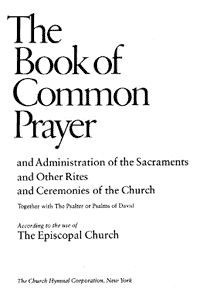
Take a good look at this prayer. You may never see it again. Let me know if you want an explanation of the arcane rubrics in the (American) Book of Common Prayer that lead to this collect's obscurity, but, as those rubrics stand, anyone reading this post will long since have assumed room temperature before it is again officially prescribed for liturgical use after Morning Prayer this coming Saturday.

That doesn't mean one can't come back to it in the course of private or extra-liturgical devotion, and I hope many do, for it is a gem of Christian piety in general and an exemplar of Anglican spirituality in particular. It crystallizes the dialectical tension between the present reality of our salvation ("what you have wrought in us") and the ongoing process of living into that reality ("make us worthy of our calling"). We do not deserve God's grace, yet He has "wrought" a new creation within us through His grace. We are not inherently worthy to be His followers, but that same grace is ready to make us worthy.

The late great A. M. Ramsey once wrote (I wish I could recall the citation): "God does not call those who are fit; He fits those whom He calls." I am grateful for that insight just about every day of my life. And I'm grateful that the Collect for Proper 1--here today and then gone for a long while--brings it to the forefront of the Church's attention this week.

Wednesday, May 14, 2008

My Sermon Blog is Back

Here.

It has lain fallow during Paschaltide because I have been preaching extemporaneously (indeed, in a most evangelical expository fashion!) through the First Epistle of Peter. But now I'm back to my more scripted (but, I hope, nonetheless engaging) homiletical mode.

Tuesday, May 13, 2008

On Lectio Divina

For those who don't look at TitusOneNine, or who didn't bother to click on the link in that venue, I do encourage you to see this article by Laurentia Johns in the (English Roman Catholic) periodical (and website) The Tablet. The practice of "holy reading" (aka "praying the scriptures") has been a regular part of my own prayer life for several years, and this is a particularly lucid glimpse into it.

I am especially grateful for Ms Johns' attention to the symbiotic connection between the reading of the Word of God in liturgy and the practice of private prayer--the first overflowing into the second, and the second enriching and enlivening the first. So often, in my observation, people compartmentalize Sunday worship and don't create channels by which it can irrigate both personal prayer and ordinary daily living.

I am also energized by the connection she highlights between personal prayer and the common faith of the Church, how the former must always be disciplined by the latter:

Such a reading, if authentically of the Spirit, will also be consonant with the teaching of the Church, the Body of Christ - Son and Spirit, the "two hands of God" always work together (Irenaeus of Lyons: see, for example, Against Heresies IV, pref., 4).

How apropos this is in an environment where so many are apt to pit dogma (in the best sense of that term) against “Spirit.”

Do give the whole thing a look.

Friday, May 09, 2008

Lost in Wonder, Love, & Praise

I seldom cry real tears. I'm just not put together that way. But I do weep in spirit over a great number of things--the ordinary sorrows of the ordinary people among whom I serve, the unspeakable suffering of the population of Myanmar who have been victimized first by a cyclone and then by a criminally inept and clueless government, and, of course, the never-dull drama of Anglican Christianity. I weep in spirit, with generous dollops of anger and grief, over the disintegration of an ecclesial universe that has been the vehicle of light and life to my soul since my early adulthood, and in which I am thoroughly formed as a Christian disciple. The level of conflict and dysfunction and uncertainty is not what I would have wished for myself at this stage of my life.

Once in a while, though, I do cry real tears--sometimes of sorrow, and sometimes of . . . I don't quite want to say joy . . . ecstasy might be more like it. When that sort happens, chances are I'm in church and chances are I'm trying to sing something. I cried during my first Easter Vigil, during the hymn right after the lights come on. I cried on Good Friday my first year in seminary, as I literally helped hold the cross while the entire assembly approached it in pairs to kneel and pray while everyone else was singing the Reproaches set to music by the Spanish Rennaissance composer Tomas Luis de Victoria.

But first prize in this category goes to Westminster Abbey. Three years ago last month I made my first (and thus far only) trip to England. On the first Sunday afternoon I was there, I found myself, without any particular planning, outside the abbey at the time they were no longer admitting tourists but were letting in those who wanted to attend Evensong and promised to stay for the whole thing. They waved me past the queue and ushered me not just into the nave but all the way beyond the rood screen into the choir. (The actual choir needed only about one-third the available space in that part of the building.) The Office Hymn that day was a familiar text, Charles Wesley's Love divine, all loves excelling. American Protestants--those who still sing hymns, at any rate--are used to singing it to a rather insipid tune called Beecher. Episcopalians associate it with the incredibly durable Welsh tune Hyfyrdol. The Brits, however, have two other candidates: the very Victorian Love Divine by Sir John Stainer, and another product of Wales, Blaenwen.

It was this last one that we sang in Westminster Abbey at Evensong on that April Sunday in 2005. I was seated next to an elderly gentleman who then lived in Greece but had been a cathedral chorister as a boy in England. We both sang our hearts out. On the last half of the last verse, the organist performed the Anglican musical version of Emeril's "kick it up a notch" cooking move, pulling a 32' pedal reed and slipping in some deliciously unexpected harmonies. But I couldn't finish it myself. I was sobbing uncontrollably. It was liminal, mystical, transcendent, and I will never forget it.

I'm not even sure YouTube even existed three years ago. But I am very grateful for it now because it allows me to revisit the same spiritual territory that I was treading that afternoon in London. The BBC has a remarkable series called Songs of Praise. It's essentially a televised hymn sing. Each program features a different venue--a cathedral, a church, or an auditorium packed with enthusiastic singers, both trained and amateur. And there is a seemingly limitless number of these hymns available on YouTube.

While searching for a rendition of Love divine... to Blaenwen, I ran across this very touching choral anthem version of the text, newly composed for a youth choir festival.

Is the human face ever more beautiful than when singing? I think not. And as much as I love at least 2.5 of the hymn tune versions already available, this one is really quite nice.

I haven't yet found a performance of Blaenwen that can come close to replicating my mountaintop experience in Westminster Abbey, but in case you don't know the tune, have a look at this one. (The singers are quite skilled, but they appear to be outfitted by the costume designer for a Star Trek movie.)

What the various commenters say about the hymn and the tune are probably of more interest than the actual performance, but still . . .

I need to never quit singing hymns, if for no other reason than that a good many of those people who most exasperate me these days are eventually going to be singing beside me and casting their crowns as I cast mine before the Lamb that was slain and the One seated on the throne as we are together lost in wonder, love, and praise. If I didn't believe that, I couldn't keep going.

Thursday, May 08, 2008

Whom Do YOU "Meet " on Sunday Morning?

Each of us is conditioned to notice certain things more than others when we encounter "the media." As a "religious professional," my ears are tuned to any mention of how people spend Sunday morning. (Naturally, I have my opinion about how they should be spending it.)

So the ears of my heart perked up when I ran across this bit from Cal Thomas' most recent column to appear in the Warsaw Times-Union (he's talking about Time magazine's list of the "100 most influential people in the world"):

Who on Time's list fits the definition of "influential"? Not Tim Russert, who is a terrific interviewer, but how much influence could he have at 11 a.m. on a Sunday morning when millions are in church? "If it's Sunday, it is 'Meet the Press'" he signs off every week. No, if it's Sunday, for more people than watch his program, it is church.

I have no intention of marking myself as a fossil by indulging in a "back in the day" rant about the due observance of the Lord's Day. (Although the first time I tried to buy a case of beer in Indiana on a Sunday, I felt like I was "back in the day"!) While I am veritably jubilant to read that there are more people in church on Sunday than watch Meet the Press, a claim I have no reason to doubt, the attitude evinced by Mr Russert in his sign-off remains an emblem of the still-emerging post-Christian era in western society.

Would I have wanted Christendom to endure a while longer--at least until I've moved on to the life to come? Sure. If given the opportunity, I would roll back the clock on that one. Here's the thing: Those of us who are leaders in the old line churches, especially those of a sacramental-liturgical ilk, are pretty much clueless about how to "do church" in any other way than the model we inherited from the era of Christendom. What I and my "religious professional" colleagues are formed for is to be faithful "village parsons"--to lead worship, preach and teach, be the presence of Christ to people at the watershed moments of their lives, and, if we're reasonaby competent, build some community along the way.

In the meantime, though, the acreage of unharvested grain is increasing exponentially (see here for a sobering reality check), and post-Christian Christianity needs to get its act together. The obstacles are a lot more formidable than competing with Tim Russert for quality time on Sunday morning.


Wednesday, May 07, 2008

Some Good Straws to Grasp At

Maybe I've been drinking the water at the Hillary Clinton School of Optimism, but I find myself encouraged by today's news that the Ordinary and the Assistant Bishop of Pittsburgh have announced that they will be attending the Lambeth Conference. This comes on top of slightly less recent news that the Bishop of Fort Worth and the Presiding Bishop of the Province of the Southern Cone will also be heading north after GAFCON before going home.

In the cavalcade of events since the 2003 General Convention lit a match to the tinder-dry Anglican forest, the worst-case-scenario-sum-of-all-fears for me and for many others has been the prospect of a monumental schism that cuts to the core of Anglicanism, with a larger chunk, mostly "Global South", spinning off into a theologically orthodox (in an Evangelical sense, with tolerance for some Catholics in their midst) but non-Canterburian post-Anglican body, leaving behind a smaller chunk, mostly European and North American, in a radically downsized but Canterbury-centered Anglicanism dominated by "progressive" theology, with some degree of tolerance for Catholics and Evangelicals who remain with them.

This nightmare scenario remains a clear and present danger. If I were a betting man (which I am so not), I would hedge my bet, but my main money would go with the split. I have long prayed for, and advocated for, an end to the ill-advised boycott of the Lambeth Conference by the Global South bishops and their allies. With a strong united front, it is still possible to consolidate the gains made in 1998 (the statement on sexuality known as Lambeth I.10) and dig a foundation for a strong Anglican Covenant, one that will enable Anglican Christianity to finally come of age for the first time in history. This Lambeth Conference had the potential to be of watershed significance. I think that potential may have been squandered by a series of rash and impatient moves (GAFCON among them) on the part of orthodox Anglicans. But the news that some key voices of mainstream Anglicanism from North America will be at the table in Canterbury this summer is welcome.